
For the first time in several years, our council is currently on track to achieve only a bronze level in the “Journey to Excellence” unit contact metric. The good news is that we have time to turn this around before year-end. As has happened in past years, I expect our commissioner staff to record a large number of simple and detailed contacts during the re-charter season.
As all the District Commissioners know, I value metrics to the extent that they help us spot areas for improvement. The important and meaningful goal is that all unit-level Scouters know that unit commissioners care about them, and that units have a connection to the resources, friendships, advice, and activities in the district. This is a noble goal. Recording unit visits is the way we expect unit commissioner to indicate that they are actually fulfilling this meaningful goal.
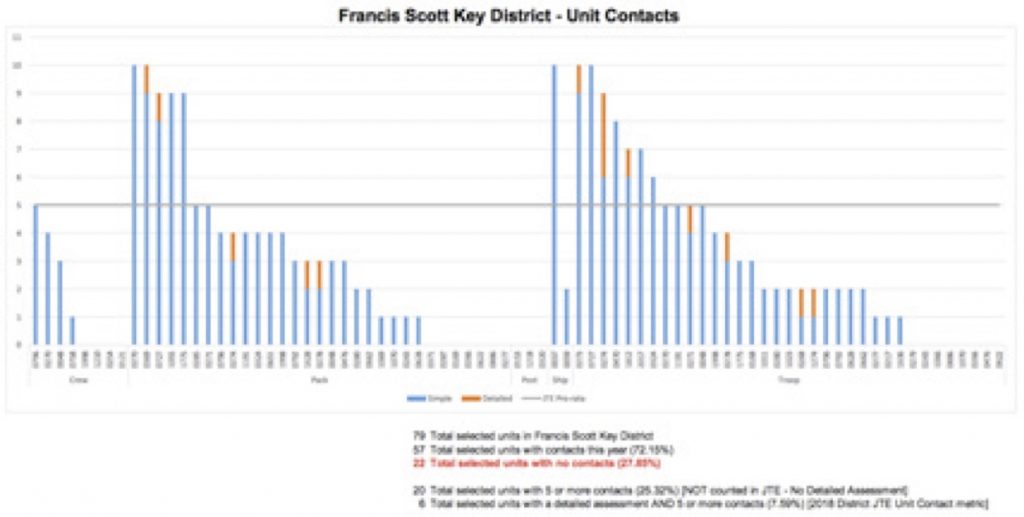
In 2018, the national “Journey to Excellence” team added a requirement to have one detailed assessment per unit to the unit contact metric. The important and meaningful goal is that unit-level leaders and unit commissioners have a discussion about where the unit stands and develop a few concrete plans on how to improve. This also is a noble goal. Recording detailed assessments does not take long, and is a simple natural by-product of an activity unit commissioners have been doing for decades. Yes, we are asking unit commissioners to do slightly more data entry, but the reason is that with this extra data entry we can easily see at a district level where units might need more service.
Allow me to use my home district, Francis Scott Key (FSK) District, as an example of how these metrics can be useful. Here is a chart (from the end of September) that uses the recorded unit contacts and detailed assessments to give a quick sketch of unit service in the FSK District.
From this chart, we can spot a few interesting things. The horizontal line shows how many contacts a unit should have received according to the Journey to Excellence standard, which is one contact per every two months (for a total of 6 per year). At this point in the year, each unit should have received five recorded contacts. You can see that 57 out of 79 units have received contacts this year. Unit commissioners may have contacted the 22 remaining units, but these contacts are unrecorded so do not show in the chart. We can see on the chart that 9 units have 4 contacts, so are just one short of the standard of 5.
The blue segments indicate simple contacts and the orange segments indicate detailed assessments. The very first unit in the chart, Crew 796, has received 5 simple contacts but no detailed assessments, so is excluded from the Journey to Excellent metrics. FSK District has 12 units like this, so when the unit commissioner performed a detailed assessment (perhaps when the unit commissioner reviews the year-end unit Journey to Excellence scorecard with the unit), these units will achieve the minimum standard required by Journey to Excellence (which is one detailed assessment per unit plus enough simple contacts).
What about the units with no or fewer than five contacts? I know that my good friend Bill Desmond, who is the District Commissioner for FSK, is working with resource constraints, like most commissioners. These units may be strong and in less need of unit contacts, or maybe they have been visited but the contacts have not been recorded, or maybe FSK is short on commissioners in those neighborhoods, or maybe the units have already folded and cannot be visited. The metrics are a quick view but the folks in our districts will have more detailed “localized” knowledge. These charts provide commissioners with the tools they can use to prioritize commissioner service, as we get closer to the year-end finish line, and I trust Bill Desmond and all of my District Commissioners to “do their best” in providing service to our units.
Assistant Council Commissioner Rick Manteuffel posts these reports to the commissioner folders each month. I ask all commissioners to use these reports as input in prioritizing commissioner service in our districts. This is not to buff our metrics, but rather to ensure our units are getting the commissioner service they need and deserve.
 As our units host their Join Scouting Nights, Colonial is pleased to announce its newest offering for youth: Sea Scout ship 818. The addition of Ship 818 has been years in the making and is the result of hours of work among several Colonial leaders. Ship 818 is chartered by Belle Haven Marina and is open to girls and boys ages 14-20. Current Colonial Scouts as well as youth not presently part of Scouting may join Ship 818. For more information, please contact George Stevens, the Ship’s Chartered Organization representative at
 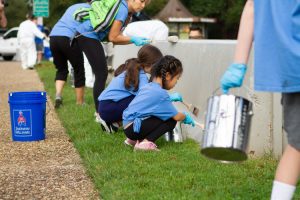 On September 22nd 400 Scouters were welcomed by the Trust for the National Mall as they converged to volunteer their time and effort to a variety of Mall-related service projects. The day also marked the National Environmental Education Foundation’s celebration of the 25th Annual National Public Lands Day. Known as the largest single-day volunteer effort, this year’s theme of resilience and restoration was inspired by a pressing need to address the effects of a spate of natural disasters and extreme weather that have taken a terrible toll on both public lands and those who depend upon them.
 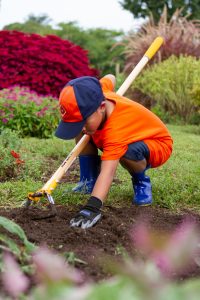 With over 35 million visits and 3,000 permitted events annually, the National Mall is the most visited National Park in the country. This level of use in “America’s Front Yard” puts an enormous strain on available resources, so volunteer efforts make a massive difference; a difference that is estimated to save the National Park Service nearly $1 million in annual labor costs. Scouts engaged in river clean up, painting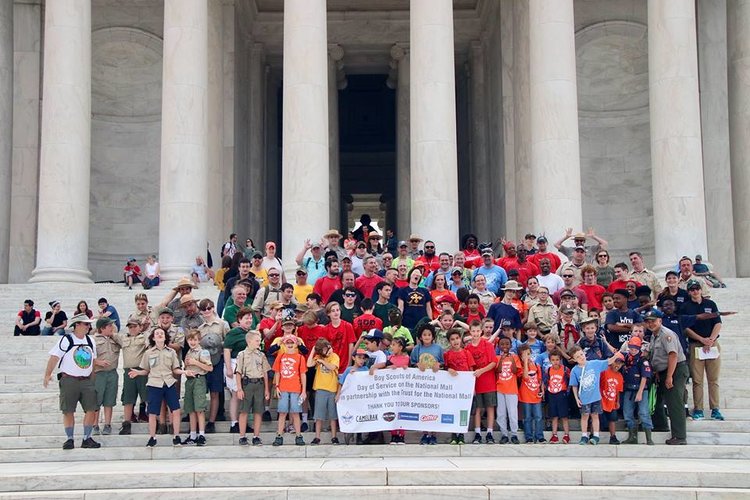
 Goshen had a big, busy summer this year! Attendance was high and weeks filled up quickly, with Week 1 being especially popular. Week 2 was more populous than normal this summer, which made the Independence Day celebration at Goshen even more fun – with field games, snacks, special trading post items and sales, and fireworks over the lake. Our Wilderness First Aid Courses, run out of the Goshen Health Lodge, were also quite popular this summer. Adult leaders from all camps took part in those and other training courses around the lake, improving their skills and getting more prepared for the outdoors and other Scouting experiences.
 NCAC will be kicking off the 31st annual Scouting for Food on November 3. Scouts will distribute door tags to homes throughout our Council, then return on November 10 to collect non-perishable food items that will nourish the area’s hungry.