 Three Scouts and three adult leaders from Troop 380 (Capitol Hill) spent August 2–9 on a wilderness canoe trek at Maine High Adventure Base at Matagamon, on the northeast edge of Baxter State Park. After a two-day drive from Washington, the crew designed its own route with an MHA guide — favoring rivers over lakes, moderate whitewater, and a real share of portaging — then spent eight days paddling, portaging, and camping in the largest undeveloped forest east of the Mississippi. Along the way they navigated wind and current across open water, cooked every dinner over an open fire, purified their own water, and stored food beneath overturned canoes in the North Woods style.
 The trek was youth-led from the first evening. Scouts ran the cooking rotation, built the fires, tracked mileage against the map, and made the daily calls on when to push for the next campsite and when to wait out the wind. One of the week’s best moments came early, when the crew leader assigned a fellow Scout to run dinner before stepping away — a small act of delegation that set the tone for the rest of the trip. By the final days the adults were mostly passengers.
The wilderness held up its end. The crew spotted two moose from the water on the eighth day, an otter the next morning, and had clear night skies most of the week. They came home tired, filthy, and already asking about the next trip. Troop 380 recommends Maine High Adventure to any unit looking for a genuine backcountry experience close to home — it’s a smaller program than the national bases, and all the better for it.
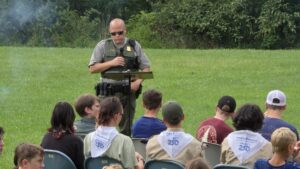
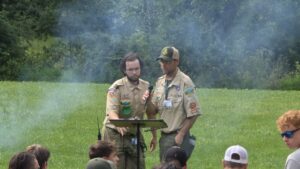
 Against the backdrop of Catoctin Mountain Park, Scouts, Scouters, staff, veterans, first responders, and community partners gathered at Camp Catoctin for a moving America 250 Flag Retirement Ceremony commemorating the 250th anniversary of the United States and reflecting on the enduring ideals of citizenship, service, sacrifice, and responsibility. The ceremony featured remarks from three distinguished guests: Marcia Deppen, Interim Director of the Governor’s Office of Homeland Security; Joe Darling, Chief Ranger at Catoctin Mountain Park, National Park Service; and Mario Perez, Scout Executive for the National Capital Area Council. Each offered a unique perspective on service, citizenship, leadership, and the responsibility we all share in strengthening our communities and our nation.
 Their remarks connected the history and symbolism of the American flag with the values Scouts strive to live each day. The ceremony also included participation from veterans, first responders, Scouts, Scouters, and Camp Catoctin staff—representing generations of individuals committed to serving others. The presence of veterans and first responders made the ceremony especially meaningful, offering Scouts a visible reminder that service takes many forms—from military service and public safety to volunteerism, civic engagement, and leadership within our communities.
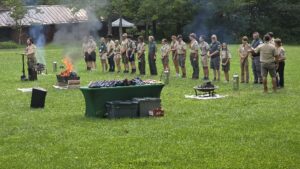 As American flags that had reached the end of their service were respectfully retired, Scouts experienced the principles of the Scout Oath and Scout Law in a powerful and tangible way. The ceremony was about more than retiring flags; it was an opportunity to understand what those flags represent and to recognize the responsibility each generation carries to preserve the ideals of citizenship, service, and respect. As America marks its 250th anniversary, Camp Catoctin was proud to commemorate this historic milestone in a way uniquely suited to Scouting: gathering together in the outdoors, honoring those who serve, reflecting on our shared history, and inspiring young people to consider the role they will play in our nation’s future.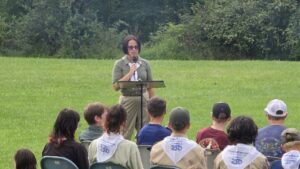


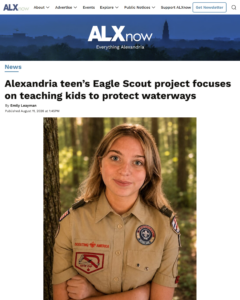 Charlotte, a Scout from Troop 130 in Alexandria, VA, was recently featured by ALXnow (Everything Alexandria) for her Eagle Scout project, which helps teach young people about protecting local waterways and the environment.
 Projects like Charlotte’s demonstrate how Scouts identify needs, develop creative solutions, and lead efforts that benefit others. By focusing on environmental education, she is helping empower the next generation to care for the world around them.
 This summer, Pack 905 of Sterling, Virginia, blasted off for an exciting day with the Northern Virginia Association of Rocketry (NOVAAR) in The Plains, Virginia.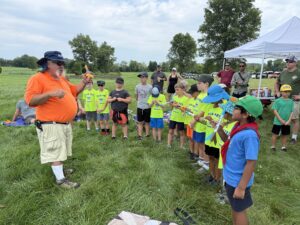

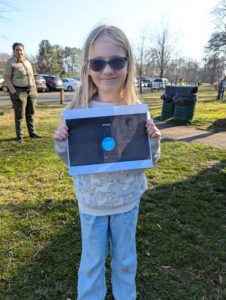
 Warrenton, VA — Cub Scout Pack 1161 and Pack 1166 enjoyed a Saturday afternoon at Rady Park learning all about our Solar System, Circuitry, Geocaching, preforming Rocket Nozzle Experiments and so much more! Thank you to Phil McBride for hosting such a wonderful event – the Scouts had a BLAST!
 STEM learning is an essential part of Scouting because it encourages curiosity, creativity, and hands‑on problem‑solving — skills that help young people understand the world around them. Activities like exploring our solar system, experimenting with circuitry, and practicing navigation through geocaching give Scouts the chance to see science, technology, engineering, and math come alive in memorable ways. These experiences don’t just teach concepts; they help Scouts build confidence as they test ideas, try new methods, and learn through discovery.
 Each Cub Scout rank now includes at least one