
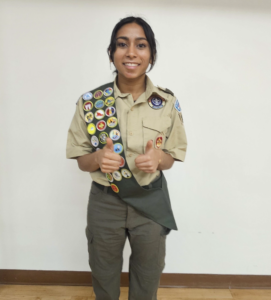
As Anuva Maloo finishes up her one-year term as the student member of the Board of Education for Montgomery County Public Schools in Maryland on June 30, 2026, she was able to reflect on how an unexpected journey through Scouting helped guide her voice, her values, and her impact. An Eagle Scout from Troop 1444, she has spent her term representing students and demonstrating how leadership skills can translate into meaningful change in complex systems.
For her, Scouting went beyond being an extracurricular activity to become a framework for decision-making which resulted in the opportunity to serve at one of the highest levels of student representation in her community.
“The Scout Law… it’s burned into my brain,” she said. “Trustworthy, loyal, helpful, friendly, kind… those values really represent the kind of leader I hope to be.”
She even referenced those principles during her swearing-in speech, using them as a guidepost for how she approached the role. Whether weighing policy decisions or listening to community concerns, Scouting gave her a moral compass that encouraged her to think not just practically, but ethically.
That perspective proved especially valuable when navigating some of the most sensitive issues facing the district.
Seeing Systems as More Than Structures
One of the most challenging topics during her term was redistricting which was a complex and often emotional issue involving school boundaries, closures, and community identity. While many approached the issue through data and logistics, she brought a different lens.
She recalled a lesson from an architecture merit badge, where she learned how even the smallest structural component of a building plays a critical role.
“If you remove what seems like a tiny piece, the whole structure can fall,” she explained.
That idea became a powerful metaphor. To her, schools are not just buildings but are ecosystems of relationships, culture, and community. Removing or redistributing even a small group of students could fundamentally alter the identity of a school.
“It’s not just about the physical structure,” she said. “It’s about the people. Even one small community – if you take it away – you lose something important.”
This ability to connect technical decisions with human impact became one of her defining strengths as a board member.
Turning Personal Experience into Policy Change
Her leadership wasn’t limited to big-picture issues. Some of her most meaningful work stemmed from deeply personal experiences, especially around equity and access.
One of the initiatives she championed focused on menstrual hygiene products in schools. Despite state requirements mandating their availability, many students reported that supplies were inconsistent or unavailable. She understood the issue firsthand.
She shared a story from an early camping trip, when she was with one of the first groups of girls in her Troop. Faced with an uncomfortable situation and unsure who to turn to, she and her peers came up with a simple solution: create their own supply as part of their first aid kits.
“It was such a small thing,” she said. “But it made a difference.”
Years later, that same mindset guided her work on the board. Instead of waiting for a perfect system-wide fix, she pushed for immediate, practical solutions like placing baskets of supplies in schools so students would have access even when dispensers failed.
“If we can focus on something small and make an impact right here, let’s see where it goes,” she said. “That’s how change starts.”
Representation Matters
As one of the few recent female student members of the board and an Eagle Scout, she is keenly aware of the importance of representation.
“I’m really proud to say that I’m an Eagle Scout,” she said. “I hope to continue to spread that message and encourage other students, especially girls, to join.”
The Power of Community
Ask her what keeps her grounded, and she doesn’t hesitate: the people.
From fellow Scouts to Board colleagues to mentors and community leaders, the relationships she’s built have been just as impactful as the skills she’s learned.
“Scouting gave me a community that’s always pushing you to be better,” she said. “Even if it was just a few other girls when I first joined, that was enough to make me stay.”
Years later, she still sees Scouting as a lifelong network that transcends age, background, and experience. “In Scouting, it doesn’t matter if someone is older or younger,” she said. “We’re just Scouts. And that connection stays with you.”
A Message for Young People
For students considering whether to try Scouting or any new activity her advice is simple: “Just go and experience it,” she said. “If you spend even one day with that community, you’ll understand.”
For her, Scouting provided a community that was always pushing her to be better and who she could always truly rely on. She leaned on her fellow Scouts and hopes they will be friends for a lifetime.
As she looks ahead, she carries forward not just accomplishments, but also a mindset rooted in service, resilience, and a belief that even small actions can create lasting change.
From campouts to Board meetings, her journey is proof that leadership doesn’t start in the boardroom. Sometimes, it starts around a campfire.
