

A Journey to South Africa
This summer, I had the incredible opportunity to travel to Johannesburg, South Africa, as part of the United States Contingent to the 2nd African Scout Moot at Arrowe Park. The Moot brought together Scouts and young adults from approximately 30 countries across the globe, creating an experience that was much more than an ordinary camping event. It was an opportunity to experience Scouting through the eyes of people from across Africa and around the world.
The theme of the Moot was “Phezulu Nangaphezulu,” meaning “Higher and Higher.” Throughout the week, I found that this theme represented much more than the activities we participated in. It inspired us to challenge ourselves, learn from others, serve our communities, and build a better understanding of the world and people around us.

I was one of five participants representing the United States within our contingent of twelve. While we come from the same country, the Moot is designed to bring people from different countries together.
The real adventure begins.
For this regional Moot, participants were divided into different paths, each offering a different adventure: Hiking, Gig Adventure (rowing), Heritage, and Caving. I chose caving.
My path was named Inyanga, meaning “Moon,” and our adventure became known as Inyanga Caving. Our group consisted of 26 participants from 11 different countries, with two awesome Path Advisors Wagner and Ruth from Brazil and Kenya respectively.
My patrol consisted of six people: Nomfundo and Sinethemba (Boke) from South Africa, Jorge from Angola, Thomas from Italy, Rayhaan from Mauritius, and of course me from the United States. Even though we came from very different backgrounds, we quickly became a well performing team.
Throughout the Moot, we participated in a variety of activities designed to challenge us in different ways.
Veldcraft focused on outdoor skills, including pioneering, ropes, and problem solving. My favorite activity during Veldcraft was taking a raft and racing another patrol across Homestead Lake situated right at Arrowe Park. My team won after struggling with keeping the raft afloat. I almost slipped into the cold water more times than I can count.
Vigil gave us an opportunity to slow down and reflect through activities such as dance, music, and bead making. I loved learning a traditional Zulu dance. A signature move was a leg kick that raised above the head and come after a big stomp with that same foot.
Gijima brought out our competitive side with volleyball, kayaking, and traditional South African games. I never thought I would be playing South African chess!
Fabrik introduced us to technology and innovation through radio, robotics, and radar. We were able to build our own robot to take home.
Each activity showed me another side of Scouting. Some activities were familiar, while others were completely new. What connected all of them was the idea that learning does not always happen in a classroom. Maybe it happens while building a pioneering structure with someone you just met, or… figuring out a problem with your patrol, or… laughing together over a game whose rules could be bent!
Ubuntu: Service Through Community

Before our overnight Sho’t Left adventure of caving, we participated in a community service project called Ubuntu. Ubuntu is often associated with the idea that our humanity is connected to the humanity of others.
We worked with recycled plastic bottles and microplastics to create makeshift bricks that could contribute to the construction of an elementary school.
It was simple but it reminded us that service does not always require enormous amounts of resources. Things that may seem like waste can become something useful with the combined efforts of people working together with creativity and purpose.
For me, Ubuntu demonstrated one of the most important parts of Scouting: leaving a legacy that will impact others, helping them grow to become bridgebuilders of our world.
Sho’t Left adventure: Caving
I would never think I would venture into narrow tunnels with just a mining hardhat and a harness. Walking into what they called “Bat Cave” sent shivers as I was dropped in. There were tons of bats flying about. We were covered head to toe in dirt.
Walking in Baden-Powell’s Footsteps
After our Sho’t Left adventure, we had the opportunity to visit Modderfontein, a location connected to Robert Baden-Powell’s time in South Africa.
Walking through a place where Baden-Powell once lived gave me a different perspective on Scouting’s history. It was fascinating to see how the movement’s early history was connected to South Africa and physically walk through areas that influenced the development of Scouting.
It reminded me that Scouting has grown far beyond its origins. Scouting has become a worldwide movement, with young people taking part in countries and cultures Baden-Powell could never have foreseen.
Egoli: Discovering Johannesburg
Another major part of the Moot was our Egoli tour, which gave us the opportunity to explore Johannesburg and learn about South African history and culture.
We visited the Sci-Bono Discovery Centre and the Africa Museum, explored Soweto, and visited the former home of Nelson Mandela.
One of the most meaningful parts of the tour was learning about the history of the Soweto Uprising, which includes the story of a young student who was killed while protesting the use of Afrikaans as a medium of instruction.
Johannesburg was not just a destination. It became part of the education of the Moot.
A Village of Global Scouting
One of my favorite parts of the Moot was the Development Village.
The area brought together organizations and initiatives from across the World Organization of the Scout Movement. Booths highlighted programs including:
* Messengers of Peace
* Scouts for SDGs
* Safe From Harm
* Ticket to Life
* Dialogue for Peace
* Interreligious Dialogue
* Life Leaders
* Digitalize Youth
* Scouts Go Solar
* Kandersteg International Scout Centre
* World Scout Moot 2029 Taiwan
For someone interested in international Scouting, this was an incredible opportunity to see just how many possibilities exist beyond our local councils and Scouting America.
The most memorable sight was a small island with a pole pointing toward Scout centers across the world. Surrounding it were the flags of the countries represented at the Moot, along with the flags of the 54 countries of the Africa region.
Not every African country was represented by a participant at the Moot. However, their flags were still flown.
I had the honor of carrying the flag of Seychelles, an island nation in the Indian Ocean.
Standing there amongst the many flags, I was touched. Each flag represents a country, a culture, and a community of Scouts, and we all gathered together for the same movement.
Learning Across Cultures
I believe that the greatest lesson I learned from the Moot was the importance of diversity and inclusion. I expected there to be many cultural differences. Those differences would affect the way we communicated, planned, and worked together.
At times, language became a genuine challenge. English was not everyone’s first language, and there were moments when I had to pull out Google Translate just to communicate an idea or understand what someone was trying to tell me.
There were also differences in how people approached situations. Something that seemed obvious to me could be completely unfamiliar to someone else. Equally, I encountered approaches that I would never have considered back home.
These differences were frustrating.
Over the week, I realized that these differences were what made the experience special.
There is no single way to lead, no single way to organize a patrol, and no single way to experience Scouting.
The uniforms, the activities, the traditions, the languages can all be different.
Underneath all of those differences are the same Scouting ideals and mission.
Scouting is about empowering our young people.
The Privilege of International Scouting
One of the most humbling lessons I learned was how fortunate I am to have access to these international Scouting opportunities.
Traveling internationally can be difficult. For many of the people I met, opportunities to travel outside their country or participate in international Scouting events are much harder to access.
That made me appreciate this experience in a completely different way.
This is a privilege and a responsibility.
To take what I learned and share it with other Scouts at home.
International Scouting is about building relationships, understanding other cultures, and realizing that the movement we participate in at home is part of something much larger.
Phezulu Nangaphezulu.
Higher and higher.
I am excited to see where Scouting takes me next.
Patrick C.
Picture 1: Flying the flag of Seychelles
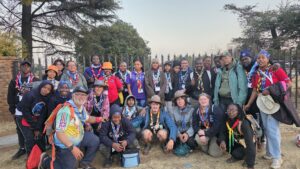
Picture 2: USA Contingent
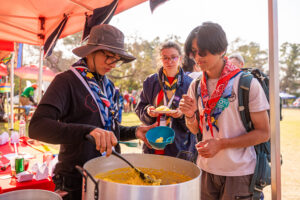
Picture 3: Trying new foods during Cultural Day
Picture 4: Ubuntu Community Service
Picture 5: Inyanga Caving Sho’t Left
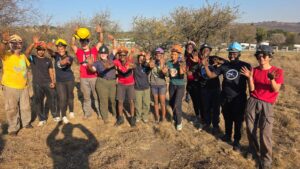
Picture 6: After Caving
Credits:
World Scouting Bureau Inc. / Johnathan Law, Lars Backes