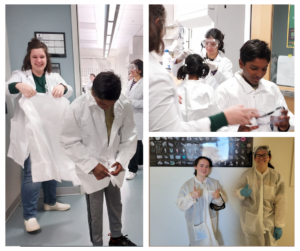
 On April 22, 2023, George Mason University’s Chemistry Club is opening their doors to Webelos/AOLs/Scouts BSA and STEM Scouts for guided chemistry workshops!
Scheduled events:
12:30 – 2pm | Session 1, Lab for grades 4-5
1:30 – 3pm | Session 2, Lab for grades 4-5
2:30 – 5pm | Session 3, Chemistry merit badge for grades 6&up
Registration:
https://scoutingevent.com/082-GMUchemistry
What to expect:
ScoutsBSA will be able to earn the Chemistry merit badge at the event. There is one pre/post-req but the workshop is otherwise structured to help scouts earn the remaining requirements.
Cub Scouts/STEM Scouts will be able to experience 3 hands-on experiments as well as gain experience in this real university Lab. GMU Chem Club will also demonstrate flame-burning magnesium!
Do you have to be a scout to attend?
No! Please invite a friend. We just ask that all youth register for the age-appropriate session.
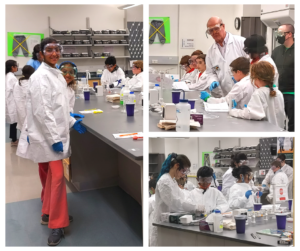
Past events
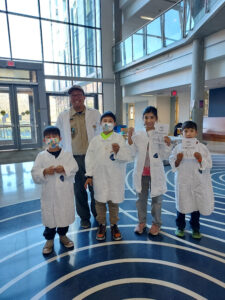
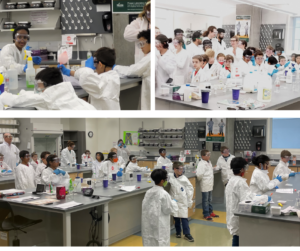
In fall 2022, the George Mason University Chemistry Club hosted 40 STEM Scouts/Cub Scouts for a remarkable Lab experience!
The GMU Chem Club dazzled our scouts with 3 hands-on experiments and demonstrations, including flame burning magnesium!
Thank you to David Lieu, former GMU Chem Club President (and current STEM Lab 314 Association Lab Manager) for connecting us to current GMU Chem Club Officers. Thank you to entire Chem Club for sharing your enthusiasm of chemistry, to the Chemistry Department for opening your doors to scouts, and to Professors Dr. Ward and Dr. Banerjee for your leadership to this event!
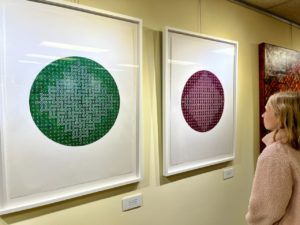 If you were to look up the meaning of Symmetry, you would find definitions that relate to mathematics, physics, and art. The
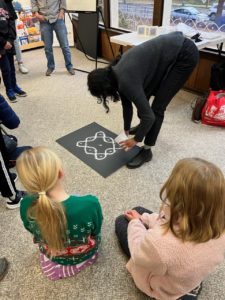
 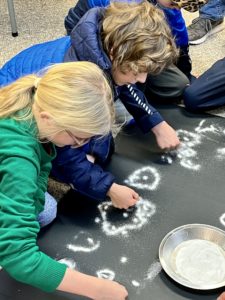 Cub Scouts learned about the history and cultural significance of the Kolam and explored the many forms of symmetry found within them. While learning to draw different Kolam, they also gained a better understanding on the concept of fractals. Aishwariya demonstrated the traditional way Kolam are created using rice flour and sand and had the Cub Scouts do their best at creating their own. Following the workshop, Cub Scouts viewed Aishwariya’s art collection called Thalaimuraigal, Three Generations of Kolam, displayed within the Gandhi Memorial Center. The collection showcases Kolam created by Aishwariya’s grandmother, mother, and herself.
 Shanthi describes Kolam as, “a versatile tool for her to explore topics she is curious about, such as cosmology, neuroscience, and math.” The connection between the art form and STEM concepts is especially clear at her art installation, Singularities and Infinities, displayed at the Katzan Art Center at American University. Pack 278 Cub Scouts ventured to the Katzan Art Center following the workshop to continue their investigation into the parallels between Art and Science.
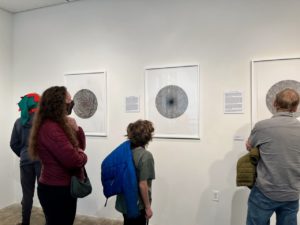 Experimental Particle Physicist, Michael Albrow, combined prose and poetry with Shanthi’s artwork to explore and express concepts of the cosmos. Found within the Artists’ Statement, the following best explains the goal of the Fearful Symmetry NOVA; “While artists and scientists view the universe through different disciplinary lenses, there is much in common – a sense of wonder and beauty, a fascination with the unknown, the boundaries of our knowledge, the perfect symmetries and broken symmetries.” Pack 278 Cub Scouts, parents, and leaders left the day with a better understanding of how symmetry can be found within their everyday life.
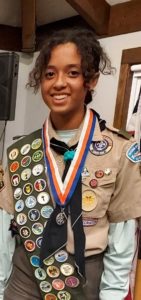 It took months to complete all of the requirements and challenges for this award, but even though at times I wanted to drop it all together, I pushed through. My favorite activities were the coding project I did, shadowing a heliophysicist, and teaching cub scouts how to make a fan powered car. Especially during the shadowing, I learned so much about what it’s like to work at NASA, and so much on recent projects and interesting things happening in the world of engineering right now.
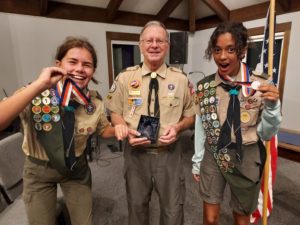 Sydney is pictured above (right) along with Lauren (left) who also earned the Edison Supernova, and Mr. Bruce Donlin (center), the Supernova Mentor for both scouts. As Sydney and Lauren display their Supernova medals, Mr. Donlin displays the Silver Pyramid, a STEM Award he was presented for creating a Council-wide, large scale, sustainable STEM event!
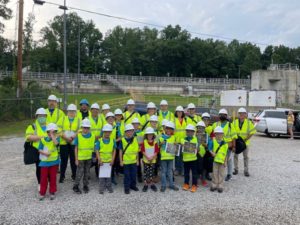 Last month, Prince William District’s Cub Scout Pack 295 had the opportunity to visit their local water treatment facility to learn about the technology used there as part of NOVA STEM’s Tech Talk adventure!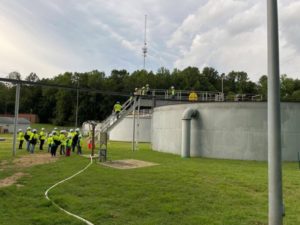
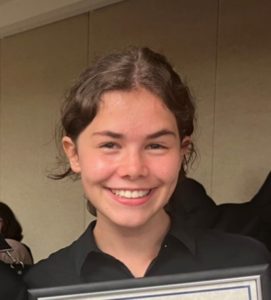 Hello, I am Lauren Nank, and I am the first woman in NCAC to earn the Thomas Edison Supernova award. I joined GT1853 right before COVID put us all into lockdown. During that time, I was introduced to the multitude of STEM opportunities in scouts. It started with the Nova awards. A Nova award is a project-based activity, and each award covers one area of STEM. I completed Let it Grow, Splash, and Mendel’s Minions. Let it Grow, taught me how we get our food, how it is processed, and a lot about food science all around the world. When I was completing the Mammal Study merit badge for the Nova award, one of the requirements was doing a project that would benefit a mammal. I decided to build a bat box. A bat box helps bats sleep and mate safely. Now, one problem was my mom was afraid of bats; but I had the opportunity to go to someone’s farm and place the bat box there. Adding on, the owner took me on a tour of the farm as well!
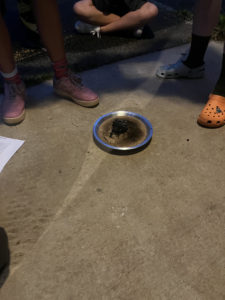 After, I completed the Splash Nova award. I learned about water use, consumption, and how water gets recycled for use again at water treatment plants. Lastly, I earned Mendel’s Minions nova award. I had been interested in genealogy at the time, so it was the perfect choice for me. I learned how to extract DNA from a strawberry with just at-home ingredients, as well as create a 3D model of DNA. Who knew you can extract DNA at home? From there, I thought Nova awards were all I could do, but that wasn’t the case. With a friend of mine, together we completed the Bernard Harris Supernova Award. A Supernova, in basic terms, is a small STEM eagle project. This Supernova taught me leadership, communication, and self-discipline. My favorite thing I did during the Supernova is interviewing and shadowing a NASA Helio physicist. I learned a tremendous amount about work at NASA, what’s next for NASA, and the work environment for women. After the shadowing, I interviewed a woman in a neighboring program; and she shared with me about the lack of women around her when she first joined. Luckily, as time went on more and more women have been getting into STEM and changing the world with it.
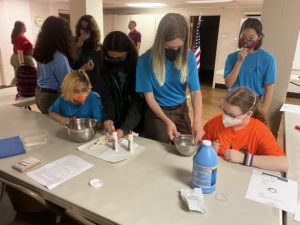 Lastly, you have to present a Nova award or STEM activity to your troop or Cub pack. My friend and I organized a meeting where we made color-changing slime and a Carbon Sugar Snake. We led scouts through both activities, and both were very different from each other. We ran into a few roadblocks with the slime, but from a different perspective, it all went incredibly well. I was proud of the results, and the positivity on everyone’s faces.
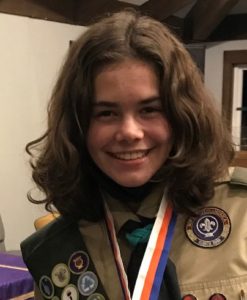 All of these awards, merit badges, and experiences not only taught me more about STEM, but how the world works, discipline, leadership, and communication online and in – person. I learned that with being open – minded new experiences could come through. Even when you feel like things aren’t progressing, everything will turn out alright in the end. I encourage everyone to get involved in STEM in your troop, or anywhere around you. I guarantee you will learn something new, or you will meet and experience new possibilities.
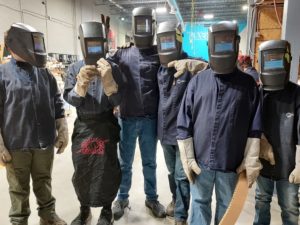 The Welding merit badge was first offered by BSA in 2012. The cover of the MB pamphlet shows a welder, safety gear, and on the bottom right corner, a patch of the BSA Nova Award. That emblem indicates that a merit badge counts for towards an additional award – a BSA STEM Nova or Supernova Award. Specifically, the Welding MB counts towards the Dr. Bernard Harris and Thomas Edison Supernova Awards. You can read their full requirements
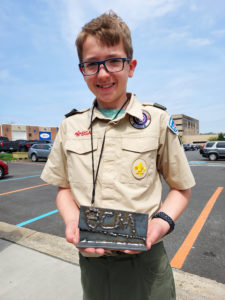
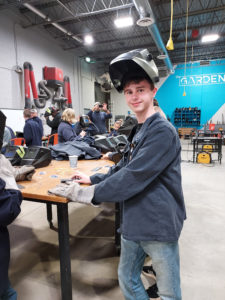
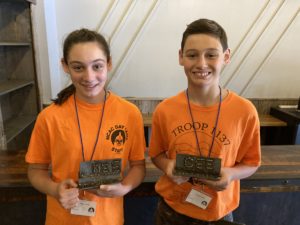
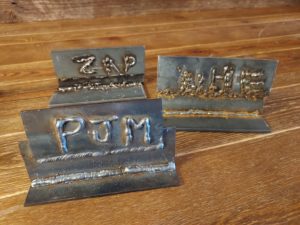
 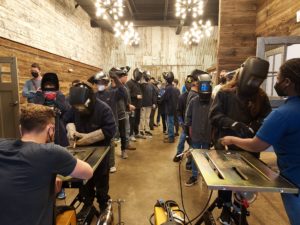 On April 23 and May 21, 2022, NCAC’s STEM Committee partnered with an Alexandria, VA based organization to offer the Welding Merit Badge class to nearly 200 scouts.
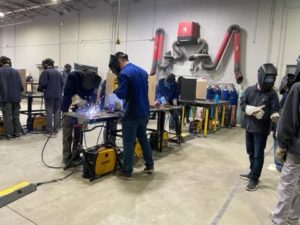 Arduinos, drones, welding, CAD, laser engraving, etc. The NCAC STEM Committee is working with Building Momentum’s Senior Education Associate, Cecily, to map Building Momentum’s incredible capabilities with scouting events.